Synthetic Regulatory Genomics
Daniel Ibrahim
Our research aims to understand the principles of gene regulation, how they control cell differentiation, and how these are disrupted in disease. We investigate these questions through systematic genome engineering. We create specific mutations in the genome and then study how they alter expression level, pattern, or any other aspect of gene regulation. To do so, we apply cutting-edge functional genomic and epigenetic analyses in cell types and tissues of clinical relevance. Our goal is to apply this knowledge to improve patient diagnosis and develop genome engineering technologies that lay the foundation for future gene and cell therapies.

Research focus
The precise control of gene expression underlies all cell differentiation during an organism’s life. The information regulating gene expression is encoded in cis-regulatory elements (aka enhancers), short stretches of DNA that are bound by transcription factors, which lie somewhat randomly skattered in the genomic area surrounding the target gene. We are interestend in all aspects related to this process.
Is the position of the enhancer relevant for its function? How does the enhancer identify it’s target gene? How do enhancers coopereate with each other? What is the influence of the surrounding DNA – the inter-enhancersequence – on its function?
We investigate these questions through systematic genome engineering. We create specific mutations in the genome and then study how they alter expression level, pattern, or any other aspect of gene regulation. To do so, we apply cutting-edge functional genomic and epigenetic analyses in cell types and tissues of clinical relevance.
A synthetic approach to studying gene regulation
Our strength is a synthetic biology derived workflow to studying gene regulation. Through combination of methods from microbiology with integrase-based genome engineering for mESCs and human iPSCs we are able to synthesize any DNA sequences of dozens to hundreds of kb and integrate them site-specific into the mESCs and human iPSCs. By combining this genome engineering approach with cell, organoid, and in vivo model systems we characterize and investigate how gene regulatory information is encoded in the regulatory genome.

Models and applications
We study gene regulation in mESCs, mouse embryos and cell differentiation models (NPCs), as well as human iPSCs and iPSC-derived organoids. We use these models to understand how cell type specific gene expression patterns and expression levels are encoded in genomic DNA sequences.
Together with our colleagues at the Berlin Institute of Health, we apply this knowledge to elucidate disease pathomechanisms, and at the same time develop technologies that lay the foundation for future gene and cell therapies.
Individual research projects
Synthetic Regulatory Genomics
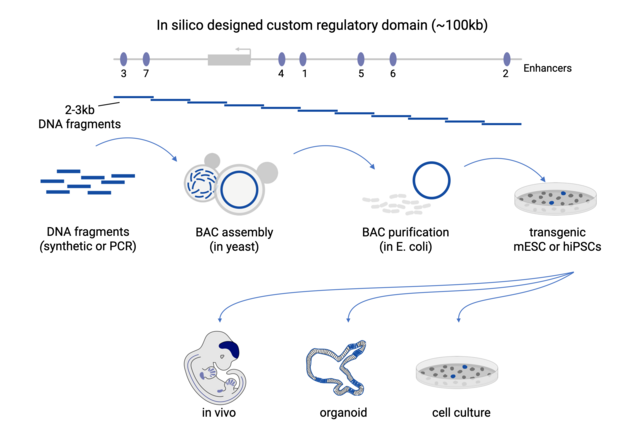
We established a synthetic biology derived workflow to studying gene regulation. Through combination of methods from microbiology with integrase-based genome engineering for mESCs and human iPSCs we can synthesize computer-designed DNA sequences of dozens to hundreds of kb and integrate them site-specific into the mESCs and human iPSCs. With this, we can effectively write large genomic regions. By combining this genome engineering approach with cell, organoid, and in vivo model systems we characterize and investigate how gene regulatory information is encoded in the regulatory genome. We are interested how synergy between enhancers and the intervening inter-enhancer sequence controls gene expression levels and gene expression patterns.
High-Throughput Genome Engineering
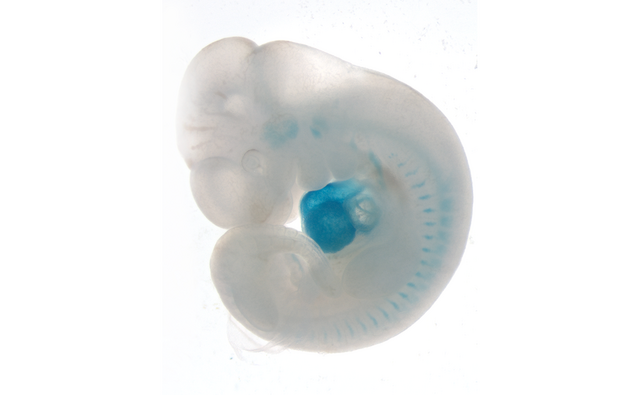
Within a gene regulatory domain usually many enhancers and multiple promoters co-exist. Yet enhancers only activate some promoters, or the other way round promoters allow only activation by some enhancers. Long-standing anecdotal evidence as well as more recent systematic studies emphasized that promoter must be capable of discriminating between enhancers. How this is achieved, however, is unknown, mainly because it requires systematic, high-throughput integration of transgenes at specific genomic loci.
In this project we adapted a Recombinase Mediated Cassette Exchange (RMCE) to investigate how different promoters respond to the regulatory elements at different genomic positions. The results will help to better understand the effects of patient mutations, evaluate detrimental effects of transgene insertions and optimize novel transgene designs.
Programming gene expression in hiPSC-derived organoids
By transfering the genome engineering technologies we pioneer in mESC to human iPS cells and hIPSC-derived organoids. Our aim is to develop new transgenic approahces that mimick the normal gene regulatory mechanisms in order to drive cell-type specifc gene expression. Through programming gene expression in human cells and hope to pave the way for a new transgenic approaches.
Functional and Computational Genomics
We generate chromatin profiles using ChIP-, ATAC-, RNA-seq as well as Hi-C to characterize the regulatory geneome in disease-relevant cell types of the heart, bone and other tissues. To better understand the regulatory factors governing these cell types we perform computatntional and functional analyses of the regulatory regions.
3D Genomics and gene regulation
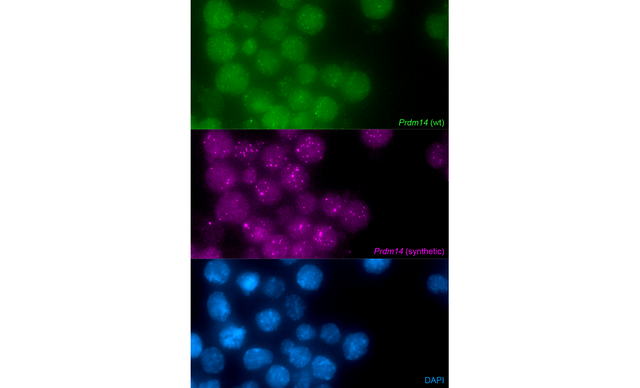
Annotation of functional gene regulatory elements has motivated the understanding of the genome’s spatial organisation. Cell-type specific gene expression is controlled by regulatory elements, such as enhancers, insulators, or boundaries, located at large genomic distances from their target genes. Thus, the physical interaction within the 3D nuclear space has emerged to be an important factor regulating gene expression.
Our work described how the genome partitioned into spatially separated units called Topologically Associating Domains (TADs) that encompass a gene and all its relevant cis-regulatory elements. Through analysis of patients with structural variations we could provide
first direct evidence for the connection between TADs and gene regulatory domains. This work had direct clinical impact through development of new diagnostic strategies for previously unsolved cases with rare genetic disease, which is now a widely accepted mutation mechanism.


Selected Publications
When 3D genome changes cause disease: the impact of structural variations in congenital disease and cancer. Weischenfeldt J, Ibrahim DM.Curr Opin Genet Dev. doi: 10.1016/j.gde.2023.102048. PMID: 37156210 (2023)
Unblending of Transcriptional Condensates in Human Repeat Expansion Disease Basu, S.*, S.D. Mackowiak*, H. Niskanen, D. Knezevic, V. Asimi, S. Grosswendt, H. Geertsema, S. Ali, Salaheddine, I. Jerković, H. Ewers, S. Mundlos, A. Meissner, D. M. Ibrahim§ and D. Hnisz (2020) Cell. 181(5): 1062 - 1079.e30 doi:10.1016/j.cell.2020.04.018.
Functional dissection of the Sox9-Kcnj2 locus identifies nonessential and instructive roles of TAD architecture. Despang, A., R. Schopflin, M. Franke, S. Ali, I. Jerkovic, C. Paliou, W. L. Chan, B. Timmermann, L. Wittler, M. Vingron, S. Mundlos* and D M. Ibrahim* . Nat Genet 51, 1263-1271, doi:10.1038/s41588-019-0466-z (2019).
Three-dimensional chromatin in disease: What holds us together and what drives us apart? Ibrahim DM, Mundlos S. Curr Opin Cell Biol. doi: 10.1016/j.ceb.2020.01.003. PMID: 32036200 (2020)
Formation of new chromatin domains determines pathogenicity of genomic duplications. Franke, M.*, D.M. Ibrahim*, G. Andrey, W. Schwarzer, V. Heinrich, R. Schopflin, K. Kraft, R. Kempfer, I. Jerkovic, W. L. Chan, M. Spielmann, B. Timmermann, L. Wittler, I. Kurth, P. Cambiaso, O. Zuffardi, G. Houge, L. Lambie, F. Brancati, A. Pombo, M. Vingron, F. Spitz and S. Mundlos. Nature doi:10.1038/nature19800 (2016)
Funding
- DFG SPP22.02
- ERC Starting Grant SYNREG
Team members
| Milan Antonovic | PhD Student |
| Silvia Carvalho | Postdoc |
| Nele Kagelmacher | PhD Student |
| Andreas Magg | PhD Student |
| Blanka Majchrzycka | PhD Student |
| Igor Minia | Postdoc |
| Julia Schwedek | MSc Student |
| Hannah Wieler | PhD Student |
| Alexandra Despang | PhD Student |
| Vinzenz May | MSc Student |
| Henrike Sczakiel | Clinician Scientist |
| Mikie Phan | PhD Student |
| Salaheddne Ali | MSc Student |
| Ania Pitas | MSc Student |