Computer Scientist and Computing Pioneer
Grace Hopper *1906-1992

(Kopie 1)
Humans are allergic to change. They love to say, ‘We’ve always done it this way.’ I try to fight that. That’s why I have a clock on my wall that runs counter-clockwise.
Mathematician and computer pioneer Grace Hopper was born in New York in 1906. She studied physics and mathematics at Vassar College, graduated with honors in mathematics from Yale University in 1930, and earned her doctorate in 1934. From 1931 to 1943 she was professor of mathematics at Vassar. In 1943 she joined the Naval Reserve as a lieutenant and in 1944 she was assigned to the Computation Project at Harvard University. There she worked on Mark I, the first large-scale automatic calculator and precursor of electronic computers. In 1949 she joined the Eckert-Mauchly Computer Corporation as head programmer on the first gener al-purpose digital computer UNIVAC I. In 1952 she pioneered programming lan guages for compilers and worked on the A-0 system, translating mathematical code into machine-readable binary code. In 1956 she developed FLOW-MATIC, the first pro-gramming language to use word commands, providing the basis for COBOL, which was the first widely used computer language, employed for many years until the 1990s. After decades working as a consultant and lecturer, Grace Murray Hop per died in Virginia in 1992. She had received more than 90 awards for her pioneering work and popularized the term “debugging” in computing.
Pictures
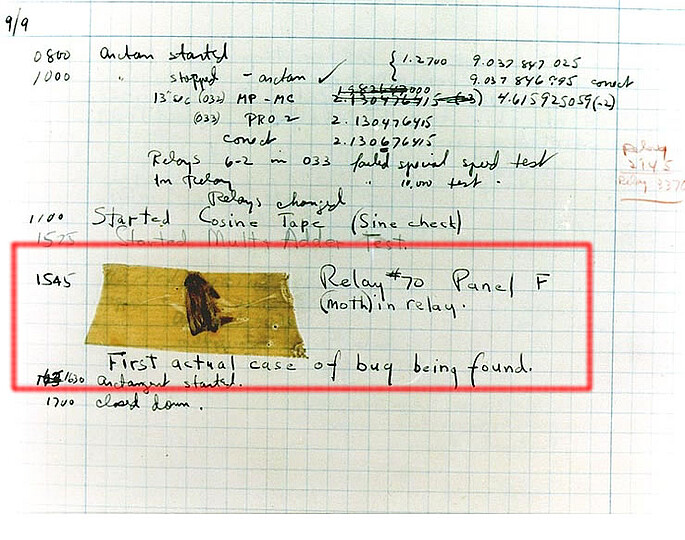
The first documented „bug“ in 1947 - a Mark II computer logbook page with a moth taped to it that had caused one of the computer‘s relays to fail. © public domain 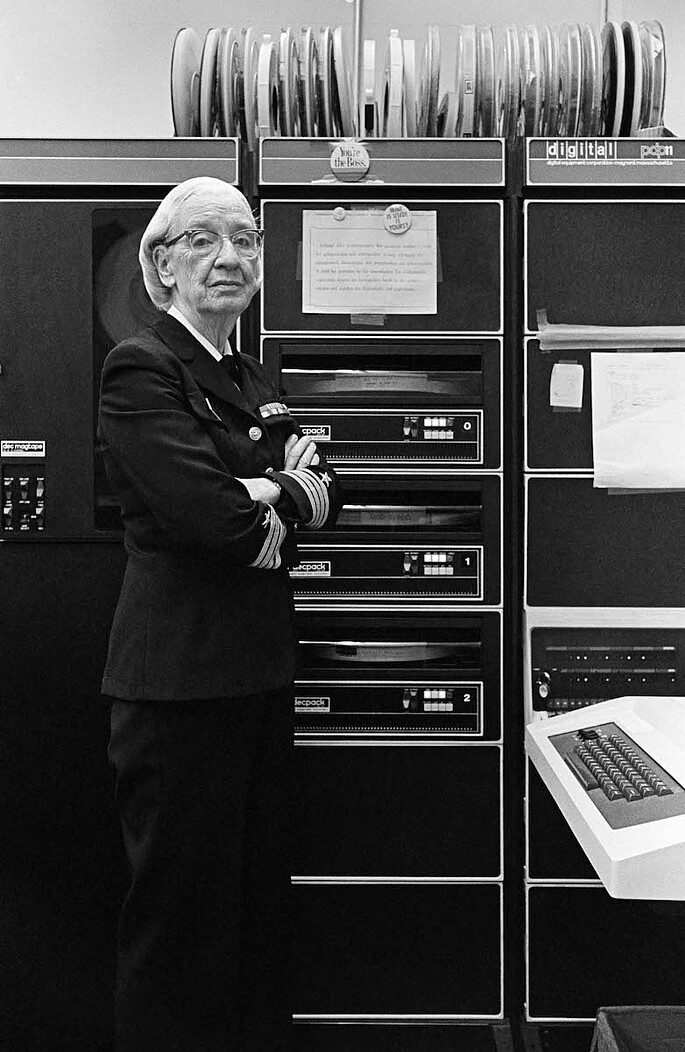
Grace Hopper, in her office in Washington DC, 1978 © Unknown (Smithsonian Institution), Grace Hopper and UNIVAC, CC BY 2.0

