Strategic Research Program 2023-2027
The BIH's Mission and Strategy
We create measurable impact for patients and communities.
Mission
Our mission is biomedical translation: we translate scientific discoveries into new approaches for personalized prediction, prevention, diagnostics and therapy — and derive new research questions from clinical observations. In this way, we connect excellent biomedical research with concrete applications for patients and translational communities.

Medical care is based on standardized, evidence-based procedures. These are indispensable, but they do not always capture the individual causes, trajectories and influencing factors of diseases. We therefore work on concepts and solutions in precision medicine that better take into account the individual needs of patients and open up new pathways towards more effective, targeted and sustainable healthcare.
To this end, the BIH creates a translational ecosystem that brings together researchers, clinicians, patients, partners from business and industry, and stakeholders from politics and society. We provide infrastructures, methods, data spaces and support services that enable robust research, innovation, translation and collaboration.
Our vision is to translate innovations in precision medicine more rapidly and reliably into benefits for patients. As a leading translational institution in regional, national and international networks, we shape translation together with our partners — turning research into health.
Our Strategy: Strengthening Biomedical Translation
The BIH strengthens biomedical translation and assumes responsibility beyond the regional level for the further development of translational research. We are committed to responsible research and explicitly align our work with the needs and perspectives of researchers and patients.
We promote a research culture that supports innovation and considers the translation of discoveries into application from the outset. Through our concepts, we enable an interdisciplinary and collaborative approach that is essential for the accelerated and efficient translation of biomedical research into healthcare. For us, translation is successful when it generates impact in four areas: (1) accelerated translation to patient care, (2) open access and use, (3) open innovation, and (4) entrepreneurship.
Science, Platforms and Programs

Within the framework of our Strategic Research Programme, we successfully pursue three interconnected and collaborative Research Objectives: (1) Responsible Translational Methodologies, (2) Computational and Functional Precision Medicine, and (3) Novel Regenerative Therapies. This is made possible by a broad spectrum of translational platforms and programmes. The BIH provides infrastructures, resources and concepts that we develop and share in partnership with regional, national and international stakeholders. They provide access to advanced technologies, methodological expertise, quality-assured processes and interdisciplinary networks. They are complemented by programmes that support translational projects along defined milestones, promote scientific careers, provide regulatory and methodological guidance, specifically support innovation activities, and accompany entrepreneurial development.
Our Translational Ecosystem

The BIH is embedded in the translational research landscape in a distinctive way. As part of Charité — Universitätsmedizin Berlin, we combine scientific research, proximity to leading university medicine and innovative capacity within an institutional environment that offers numerous points of connection for internal and external collaboration. This environment is complemented by the privileged partnership with the Max Delbrück Center for Molecular Medicine in the Helmholtz Association, as well as by further alliances with academic institutions, non-university research partners, companies and industry partners. As a result, the BIH is networked regionally, nationally and internationally and is able to bring together scientific, clinical, technological and application-oriented perspectives in a targeted manner.
Its distinctive institutional constellation makes the BIH a pioneer in the German research landscape. As an institute supported by the federal government and the State of Berlin, while at the same time integrated into a leading university hospital, the BIH assumes a responsibility that extends beyond Berlin. It supports initiatives with national impact, fulfils its national mandate and contributes to the further development of biomedical translation as a shared task of science, healthcare, innovation and society.
Question & Answer
-
What does patient and community orientation mean?
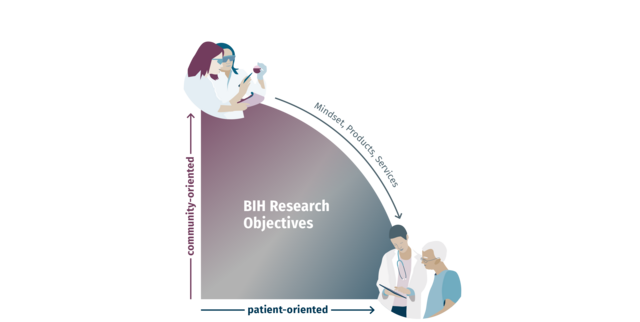
- Patient orientation: Patient-oriented research seeks to deliver tangible benefits to patients by centering their perspective, including: first awareness of symptoms, personalized prevention, deep phenotyping and diagnostics, improved treatments, and innovative aftercare.
- Community orientation: Community-oriented research seeks to serve scientific communities and beyond by creating useful tools and services for innovation with direct or indirect benefit for patients. This includes developing novel approaches, useful analysis tools, and new products, solutions, services, and platforms for the scientific community, as well as contributing to guidelines, standards, protocols, and best practices.
Both approaches require iterative feedback mechanisms for constant improvement and a commitment to responsible translation, promoting and teaching practices that produce robust, transparent, and ethical results with efficient use of resources.
-
What is behind the impact in four areas of successful translation?
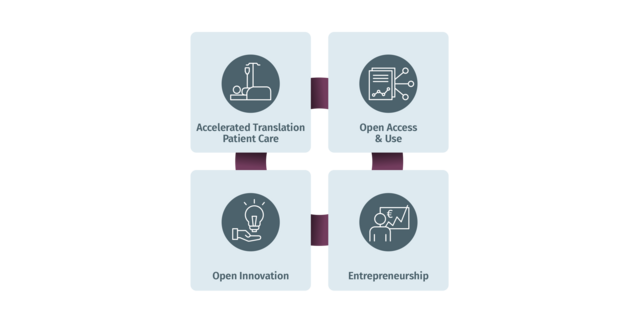
Our endpoints for successful translation reflect innovative impact in four areas:
- Accelerated Translation to Patient Care: directly impacting patient care via responsible research in situations where lengthy product development is not required e.g. some forms of computational approaches, or patient-centered design of clinical trials
- Open Access and Use: providing scientists within the BIH and beyond with access to data and analytical tools to improve patient outcomes and to support evidence-based practices, while addressing challenges related to data privacy, security, and intellectual property rights
- Open Innovation: fostering collaboration and transparency beyond the BIH and the Charité in order to develop novel solutions to benefit patients, while increasing efficiency in the healthcare, pharmaceutical, and biotech sectors
- Entrepreneurship: creating intellectual property, products, and spin-offs to transfer knowledge into innovative solutions for the market, while ethically balancing economic goals and patient welfare.
-
How exactly are we pursuing our three research objectives?
The three Research Objectives bring together Research Groups and all units of the institute, scientific and administrative, while facilitating responsible translational research and nurturing a translational culture. We are thus open to new formats for co-creation, co-working, co- development, and co-education with partners from start-ups, industry, patient representatives, regulators, investors, and other translational stakeholders. Our unifying goal is to create measurable impact for patients and translational communities.
- Responsible Translational Methodologies for biomedicine: Our goals include robust reproducible research; transparent open access to research results and data; validated incentives and key performance indicators (KPIs); education; and a patient-centered translational culture at the BIH, with outreach to Charité, the translational ecosystem in Germany and beyond. Blending approaches from metascience and scientific standards, this Research Objective offers coordination and support for education and training, as well as project guidance for technology transfer. In particular, the various Core Units continuously develop infrastructures (technology, methodology, applications) to support preclinical and clinical research. Another key component is the development of FAIR (findable, accessible, interoperable, reusable) data platforms, which protect personal data while facilitating its use for healthcare and research. To unlock the full potential of data science in medicine, it is necessary to ensure data protection and interoperability while addressing federal structures which are particular challenging within the EU and Germany. By productively fusing responsible research, robust methodology, open science, and meta-research, this Research Objective embodies our view of translation as a science.
- The Computational and Functional Precision Medicine Research Objective takes an interdisciplinary approach to predictive and preventive personalized medicine, covering all aspects of data-driven and functional experimental research. This ranges from the use of artificial intelligence to the analysis of large health-related datasets using state-of-the-art biomolecular analytics in experimental studies to identify disease mechanisms. The goal is to match individuals with personalized prevention plans and interventions, addressing key steps of the patient journey. For example, we seek to deliver insights into diseases to facilitate decision support, as well as designing novel treatments and aftercare procedures. Our activities here also help shaping the field around medical informatics and bioinformatics Germany-wide.
- Using different biological and mechano-biological approaches, the Advanced Regenerative Therapies Research Objective seeks to achieve homeostasis or restore the function of diseased or damaged tissue in patients with various progressive chronic diseases, acute illnesses, and injuries. Together with the Charité and MDC, we are developing the field of advanced therapies, including matrix-based approaches, cell therapy, and gene therapy. Our team includes experts in regulatory science, who collaborate with the responsible authorities to develop regulatory processes for novel therapies. Additionally, we seek internally and in collaboration with external manufacturers to optimize production processes for Advanced Therapy Medicinal Products (ATMPs) aiming to swiftly transfer these products to the clinic. This Research Objective profits from collaborations with academia and industry, and from the BIH’s role in moderating a National Strategy for Gene and Cell-Based Therapies.
-
How do the BIH platforms and programs support translation?
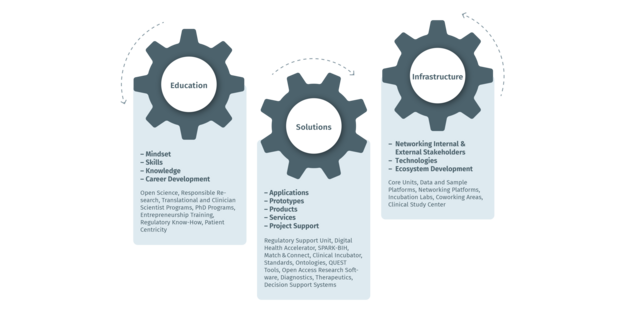
The BIH has established a unique ecosystem of support Platforms and Programs to enable effective translation through education, solutions and infrastructures.
- Translational Support Platforms include the BIH Core Units, such as Technologies and Expertise for Integrative Multi-Omic Approaches; Tissues, Biospecimens, and Cellular Models for Research; and key tools and infrastructure for Data and Sample Platforms. The BIH Core Units continuously develop their service and technology portfolio, working with users to meet their needs and exploit the latest technological developments. In addition to analytical services, the Core Units offer project consulting, user training, and workshops to strengthen reproducible and valid research at the BIH and beyond. BIH, Charité, and MDC scientists can use the OpenIRIS portal to book services offered by these units. In addition to the Core Units, there are a number of Translational Support Platforms that are orchestrated by several Research Groups or centers (e.g. the Clinical Study Center, the QUEST Center). This includes a number of Data and Sample Platforms and the Responsible Research Toolbox. Independent Networking Platforms also foster connections between researchers and stakeholders within thematic communities.
- Our Translational Support Programs provide funding and coaching programs to achieve innovation researcher advocacy, and researcher empowerment within the BIH and the broader translational ecosystem. For example, Charité BIH Innovation (CBI) provides the Digital Health Accelerator, SPARK-BIH, and Match & Connect programs. The newly created Regulatory Support Unit, the Clinical Incubator for advanced therapies as well as the Clinician Scientist Program and its tailored variations provided by the Biomedical Innovation Academy (BIA) complement the portfolio. The Strategic Science Management supports the BIH research community and the Board of Directors in implementing
our mission.


