BIH Excellence Award Previous Winners Update

Despite years of effort and recognition of importance, sex and gender differences are still often overlooked in researh design, study implementation and scientific reporting. Important knowledge gaps damage the chances of succesfull translation from bench to bedside. Sex- and gender-based studies and analyses are crucial to expand our knowledge and udnerstanding of health and disease and enhance the scientific quality of the results. Thus, the Berlin Institute of Health (BIH) is awarding the BIH Excellence Award for Sex and Gender Aspects Health Research every second year since 2017.
The award aims to promote sex and gender issues in translational research and increase visibility for these topics. In 2019, Antoinette Maassen van den Brink received the award to advance the knowledge and understanding of sex and gender differences in migrain. In 2017, a jury of international experts awarded Louise Pilote, who specialises in social gender differences in cardiovascular research, and Rhonda Voskuhl, who investigates sex differences in degenerative diseases such as multiple sclerosis. Since then, their research continued to tackle the questions and knowledge gaps with hope to lead to better understanding of the diseses and thus better treatment for patients. Below you can find their current thoughts on the subject.
"Studying sex and gender in medical research should not be considered as something specil, but it should be part of everyday scientific life." - A. Maassen van den Brink
"The study of sex differences in disease reveals important clues into naturally occurring disease modifying factors. Understanding these sex differences and what causes them can lead to new treatment targets for novel therapies for each disease. " - Rhonda Voskuhl
"In clinical research, it is important to have a clear picture of how sex and gender may affect results obrained in a study, which aspects would be relevant for one of the genders only, and which conclusions may be drawn from a study." - A. Maassen van den Brink
"Research questions and data analysis plans should be defined while clearly considering the influence of sex and gender." - A.Maassen van den Brink
Winners
-
Antoinette Maassen van den Brink
Studying sex and gender in medical research should not be considered as something special, but it should be part of everyday scientific life. Sex and/or gender are important determinant in research of all levels, i.e., biological/preclinical, clinical, and population-level research. In biological/preclinical research, biological sex may be a more important determinant than gender, which is influenced by behavioural and societal aspects. Even in experiments on isolated cell cultures, results obtained in cells isolated from a male individual may differ substantially from results obtained in female cells.
Further, it is obviously important to consider the sex of experimental animals. In this respect, many researchers have in the past preferred to use male animals only, expecting the variability of the results to be smaller in male animals than in female animals with an estrous cycle.
However, as was recently demonstrated , variability between male animals is not smaller than that between female animals, in view of differences between dominant and subordinate males. In clinical research, it is important to have a clear picture of how sex and gender may affect results obtained in a study, which aspects would be relevant for one of the genders only, and which conclusions may be drawn from such a study. In both preclinical and clinical research, it should not be a dogmatic rule to have the same group sizes for male and female individuals, as this may lead to unethically and financially not feasible large research populations. Rather, research questions and data analysis plans should be defined while clearly considering the influence of sex and gender. Population-level research can teach us a lot about sex and gender differences in health and disease. In this context, it remains a challenge to properly disentangle the components of sex and gender, respectively, which may obviously also interact with each other.
In our migraine-related research, facilitated by the BIH grant 2019, we have recently reviewed existing knowledge on this topic. In addition, we identified knowledge gaps and set priorities for further interdisciplinary and translational research on sex and gender differences, as well as gender-specific therapies, in migraine.
-
Louise Pilote
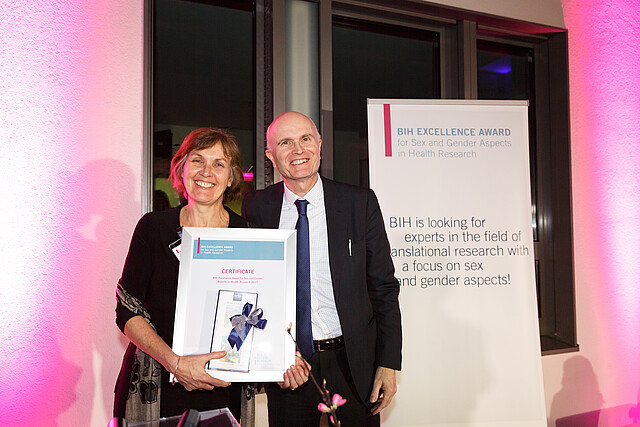
2017 ging der BIH Excellence Award an Louise Pilote, die in Zusammenarbeit mit mir, Vera Regitz-Zagrosek, und dem Institut für Geschlechterforschung an der Charité neue Konzepte zur Einführung des soziokulturellem Geschlechtes, Gender, in klinische Studien entwickeln wollte. Der Preis war eine Initialzündung. Wir entwickelten Ideen, wie die Konzepte aus Kanada auf Europa übertragen werden konnten, und von der ursprünglichen kardiovaskulären Kohorte auf andere medizinische Bereiche. Es resultierte das BMBF geförderte Projekt Gendage, das sich mit Geschlechterunterschieden im Alter auseinandersetzte, GeSeMS, ein Projekt zu Geschlechterunterschieden bei multipler Sklerose , gemeinsam mit Professor Stefan Gold in der Neurologie der Charité, und ein Projekt zu Geschlechterunterschieden bei Frailty und Tumoren, das vom DZHK unterstützt wurde. Und natürlich wurden die Gedanken zu Sex und Gender in die Forschung bei COVID eingebracht, vor allem In Zusammenarbeit mit den Kolleginnen an meiner neuen zweiten Wirkstätte an der Universität Zürich in ein Projekt des Schweizer National Nationalfonds – Sex, Gender und COVID – und ein Projekt der Stiftung „The Loop“. Da alle gestarteten Projekte Langzeitprojekte waren, wird es noch dauern, bis die Ergebnisse publiziert sind.
Erste Veröffentlichung finden Sie hier:
-
Rhonda Voskhul
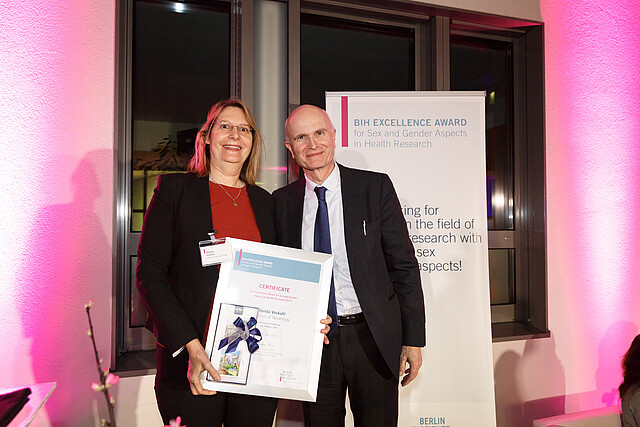
The study of sex differences in disease reveals important clues into naturally occurring disease modifying factors.Understanding these sex differences and what causes them can lead to new treatment targets for novel therapies for each disease.
In multiple sclerosis for example, women are affected about three times more often than men. My lab recently identified X chromosome effects that can lead to increased susceptibility to autoimmunity in women as compared to men. One paper (JCI) shows an effect of an X chromosome gene Kdm6a and the other paper (PNAS) shows a role of imprinting of X genes due to parental-of-origin effects, each on autoimmunity. These papers will be discussed in the context of each other and other sex chromosome effects during first symposium of this year’s annual meeting of the Organization for the Study of Sex Differences (OSSD Virtual 2021).
Also in multiple sclerosis, while women are more susceptible to developing disease, when men get MS, they demonstrate worse disability and worse brain atrophy.
A study was recently published as a collaboration between Charite (Friedemann Paul, Stefan Gold, Claudia Chien) and UCLA (Rhonda Voskuhl, Allan MacKenzie-Graham, Kevin Patel) which shows more atrophy of regional gray matter in MS men compared to healthy men versus that observed in MS women compared to healthy women.
A key aspect off this work was that since there are known sex differences in brain regions in healthy people. Previous studies compared brain region volumes in MS females versus MS males, so were confounded by known sex differences in volumes of brain regions during health. Instead our group removed this confound by comparing MS versus healthy within each sex to reveal the effect of disease on atrophy within each sex. This study was made possible by imaging data from Charite from both MS and healthy individuals.
This approach can now also be applied to other neurodegenerative diseases with a sex difference including Alzheimer’s disease and Parkinson’s disease.


