Microbiologist and Genetic Engineering Pioneer
Esther Lederberg *1922–2006

Dr. Esther Lederberg has enjoyed the privilege of working with a very famous husband. This has been at times also a setback, because inevitably she has not been credited with as much of the credit as she really deserved.
Esther Lederberg, a microbiologist and pioneer in bacterial genetics, was born in New York in 1922 to a poor Orthodox Jewish family. After studying biochemistry at Hunter College, she won a fellowship to Stanford University, working as an assis-tant in the genetics lab to finance her studies. Despite having to hold down a job, she graduated with a master’s degree in genetics in 1946, the same year she mar-ried Joshua Lederberg. She earned her doctorate at Wisconsin University in 1950, having discovered the lambda phage, a bacterial virus that is still used as a key tool in molecular biology. This marked a milestone in microbial research. Along with her husband, she developed the technique of replica plating to transfer bacterial colonies to Petri dishes which is still widely used today. She also discovered the fertility factor. In 1958, Joshua Lederberg was awarded the Nobel Prize in Physi-ology or Medicine for this work on bacterial conjugation without recognizing Esther’s contribution. The Lederbergs divorced in 1966. Throughout her research career, Esther Lederberg faced gender-based discrimination and had to struggle for professional recognition at Stanford. She retired in 1985, married engineer Matthew Simon in 1993, and died in 2006.
Pictures
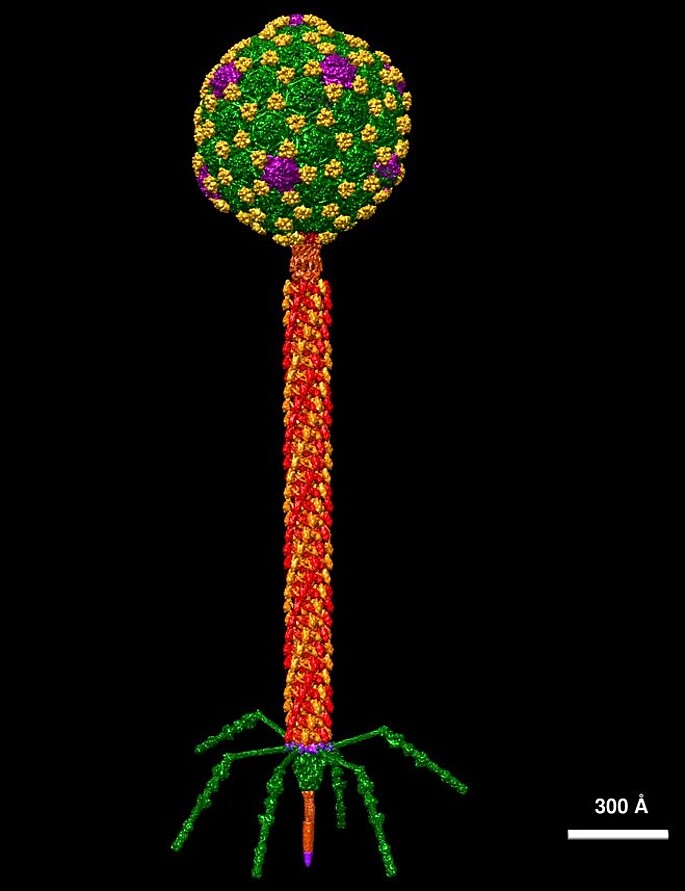
Atomic resolution structural model of bacteriophage lambda by Dr. V. Padilla-Sanchez, first discovered by E. Lederberg © Dr. Victor Padilla-Sanchez, PhD, Bacteriophage Lambda, CC BY-SA 4.0 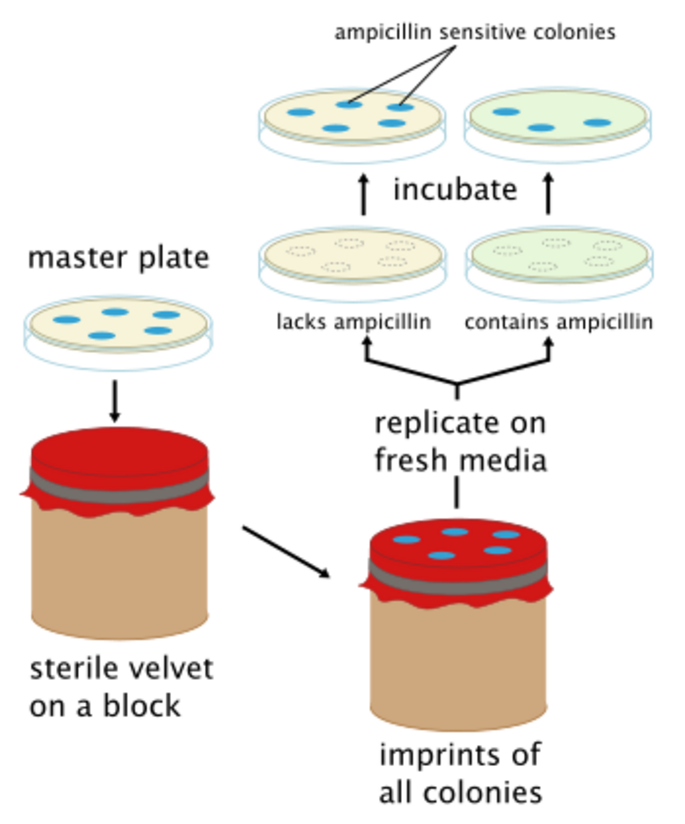
Diagram showing the replica plate technique for transferring colonies from a primary to a secondary plate, used here to negatively screen for ampicillin-sensitive colonies © Histidine, Replica-dia-w, CC BY-SA 3.0

